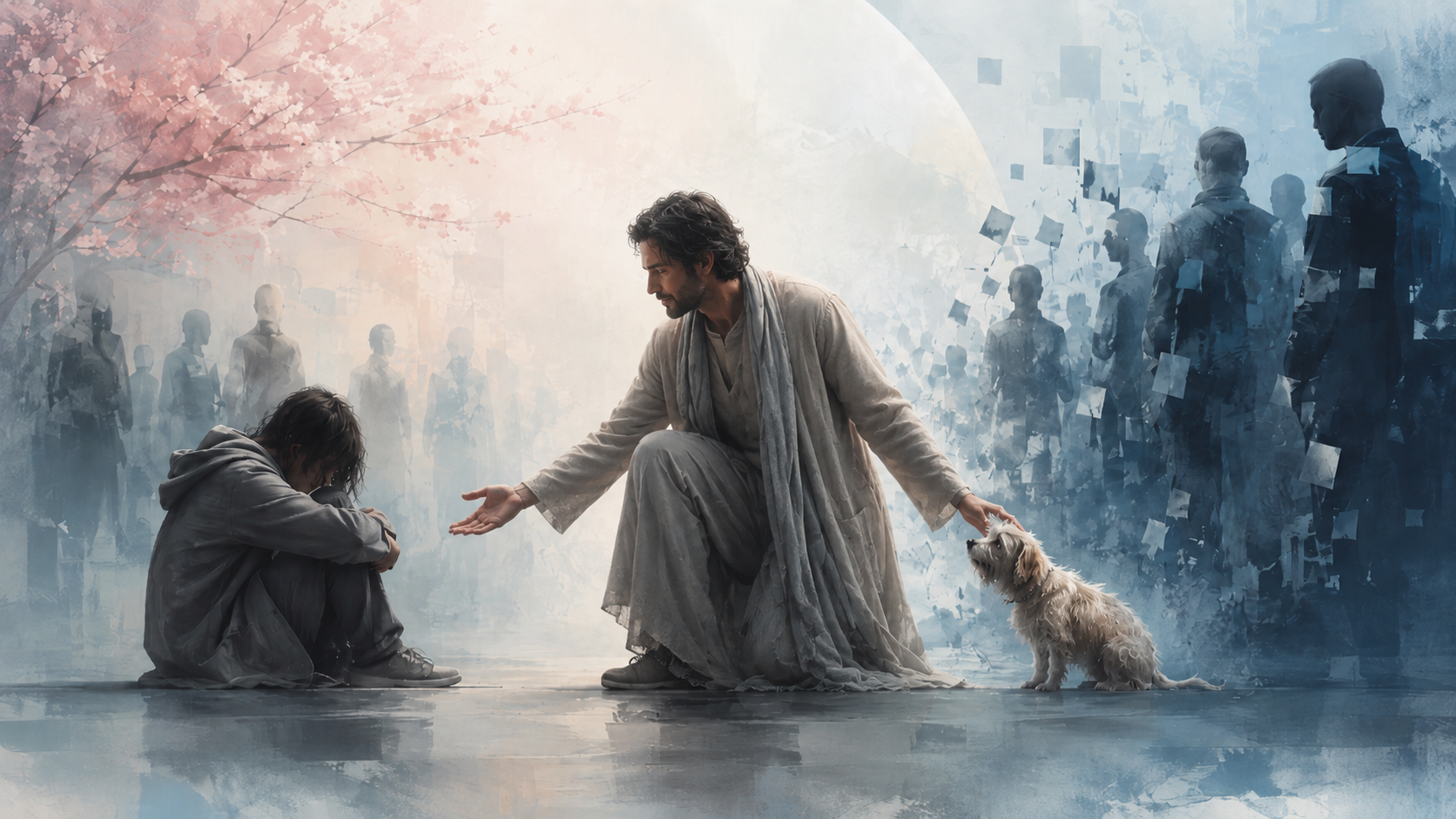
There are moments when we look at the world and wonder what has happened to us. A person is mocked because of their body. Someone delights in the humiliation of a political opponent. A frightened immigrant is treated not as a person but as a threat. A homeless person becomes part of the scenery. An animal is deliberately harmed while others laugh. Images of suffering move across our screens, and instead of compassion they sometimes evoke contempt, ridicule, or indifference. We sometimes describe such moments as lost humanity—the sense that our capacity for recognition, compassion, and restraint has begun to erode.
We often describe such moments by saying that people have “lost their humanity.” The phrase is powerful, but it also raises an important question. Can humanity actually be lost?
Biologically, of course, the answer is no. A person who behaves cruelly does not cease to belong to the human species. But there is another meaning of humanity, one that concerns not what we are biologically but how we live. It concerns our capacity to recognize another being, to respond to vulnerability, to care about suffering, to exercise restraint, and to acknowledge dignity even when doing so is inconvenient.
In that sense, humanity is not simply something we possess. It is something we enact.
We have a tendency to turn the movements of human life into nouns. We speak of identity, character, compassion, dignity, morality, and humanity as though they were things stored somewhere within us, possessions we acquire and then permanently retain. But human life may be better understood through verbs. We interpret, respond, recognize, care, dismiss, protect, exploit, forgive, humiliate, learn, resist, and change. We are continually participating in what we are becoming.
Humanity belongs to that same grammar. We do not merely have humanity. We practice it.
And because it is practiced, it can expand or contract. We can become more humane, but we can also become less so.
When Humanity Becomes a Verb
Most of us would probably describe ourselves as compassionate people. We love particular people deeply. We care for friends who are sick or grieving. We help family members, contribute to causes, comfort frightened children, or respond generously when someone we know is in need. None of that should be discounted. Compassion is real wherever it occurs.
But compassion can also have boundaries.
A person may be extraordinarily kind within a family and remarkably cruel outside it. Someone may defend the dignity of people who share their race, religion, nationality, politics, or social class while treating those outside that circle with contempt. A person may be deeply gentle with other human beings while remaining indifferent to the suffering of animals. Compassion can therefore coexist with exclusion.
This is why it is useful to think of humanity as an activity rather than a possession. If humanity were something we simply had, then kindness in one part of our lives might appear to settle the matter. But if humaneness is enacted, the more revealing questions become broader: Whose suffering are we capable of recognizing? Whose fear matters to us? Whose humiliation disturbs us? Who remains visible to us as a living being, and who disappears behind a category?
The fullness of humanity may have something to do with the widening of that recognition.
When Categories Replace Beings
Human beings categorize constantly. We could scarcely understand the social world without doing so. We notice age, occupation, nationality, religion, political affiliation, race, gender, body size, social class, and countless other distinctions. Categories can also be essential to identifying patterns of discrimination and inequality.
The problem begins when the category becomes more real to us than the being it describes.
A person stops being someone with a history, relationships, fears, contradictions, talents, failures, hopes, and vulnerabilities. Instead, they become the immigrant, the conservative, the liberal, the Muslim, the Christian, the transgender person, the addict, the prisoner, the homeless person, the disabled person, the old person, the poor person, the fat person, the foreigner, or the enemy.
Once that happens, the category begins doing our thinking for us.
Consider fatness. A fat person may be encountered not simply as a person inhabiting a particular body but as someone whose body is assumed to reveal something about their character. They may be judged lazy, undisciplined, irresponsible, unhealthy, unattractive, or lacking self-control. A physical characteristic becomes a moral diagnosis, and the complexity of the person disappears behind assumptions attached to a body.
From there, humiliation becomes easier. Mockery can be dismissed as humor. Discrimination can masquerade as concern. The person being judged may be expected to tolerate comments that would be recognized as intrusive or cruel if directed toward another characteristic.
The mechanism is not unique to body size. We see it whenever a complicated life is compressed into a label: “an illegal,” “a junkie,” “one of those people,” “a MAGA,” “a leftist,” “a criminal.” The word begins to obscure the life.
The person has not disappeared. Our capacity to see the person has.
Interpretation Shapes the Moral World
This process can be understood through the movement I have described as EIR: Experience, Interpretation, Response. Something happens, we interpret what it means, and we respond.
Imagine encountering someone whose political beliefs are radically different from your own. The encounter itself is the experience. Almost immediately, however, interpretation begins. Perhaps you think the person is mistaken. Perhaps you regard them as ignorant, dangerous, immoral, threatening, or even evil.
Those interpretations matter because they create different possibilities for response. If I interpret someone as mistaken, I may disagree with them. If I interpret them as dangerous, I may want to restrict them. If I interpret them as contemptible, humiliation becomes easier to justify. If I decide that they are somehow less deserving of dignity than people like me, their suffering may gradually begin to matter less.
The experience has not changed. The interpretation has changed the moral landscape around it.
The same movement occurs when we encounter poverty, disability, addiction, unfamiliar religions, racial or ethnic difference, people whose bodies violate cultural expectations, or people whose gender and sexuality challenge assumptions we have inherited. We do not simply respond to another person. We respond to what we have interpreted that person to be.
That is why interpretation carries moral weight. It can enlarge recognition, but it can also narrow it. It can open the possibility of curiosity and compassion, or it can make contempt seem reasonable.
And the process does not stop with a single response. The response itself becomes part of what happens next. What we practice becomes easier to practice again.
The Circle Does Not End With Our Species
The same question extends beyond human relationships.
We encounter another sentient being and immediately interpret what that being is: companion, pet, pest, livestock, wildlife, property, nuisance, food, threat. Those categories may serve practical purposes, but they also influence what kinds of treatment we regard as acceptable.
A dog’s fear may evoke immediate concern because the dog is understood as a beloved companion. The fear of another animal may be ignored because the animal has been placed in a different category. Yet the capacity to experience fear, pain, distress, comfort, attachment, or safety does not necessarily disappear simply because our terminology changes.
This does not mean that every ethical question involving animals has a simple answer, nor does it require pretending that all species or all circumstances are identical. Human relationships with other animals are complicated. We live with them, depend upon them, protect them, fear them, eat them, study them, and sometimes kill them. Reasonable moral disagreement exists about many of those relationships.
Deliberate cruelty, however, presents a more fundamental problem. What happens within us when another sentient being’s suffering becomes entertaining? What are we practicing when pain produces amusement rather than concern?
A person can be extraordinarily kind to other people and intentionally cruel to animals. Their kindness toward people remains real, but something is nevertheless missing. Their compassion has encountered a boundary beyond which suffering no longer commands recognition.
Perhaps the fullness of humanity cannot be measured solely by how well we treat those who resemble us or those from whom we receive affection in return. It may also be revealed by how widely we are capable of recognizing vulnerability and suffering as morally significant.
The moral circle can widen. It can also contract.
Cruelty Forms the Person Who Practices It
When cruelty occurs, our attention understandably goes first to the being who suffers. Yet cruelty also has consequences for the person practicing it.
If I repeatedly humiliate people I dislike, humiliation becomes easier. If I repeatedly laugh at another’s suffering, laughter becomes more available the next time. If I continually describe particular people as disgusting, stupid, dangerous, worthless, or undeserving, those interpretations begin to establish habitual pathways through which future encounters will be understood.
Responses do not simply express character. Repeated responses also help create character.
This is one reason the normalization of cruelty should concern us. Human beings are remarkably adaptable. We can become accustomed to practices that initially disturbed us. A cruel remark that once produced discomfort may eventually seem ordinary. Repetition dulls resistance. What once seemed unacceptable can become merely the way people talk.
Eventually, we may begin participating in behavior we once would have condemned.
This is not confined to spectacular historical examples of persecution or political violence. It happens in schools, families, workplaces, neighborhoods, religious communities, friendship groups, online spaces, and political movements. Wherever contempt is rewarded and humiliation is treated as entertainment, people are being formed.
Cultures are formed in much the same way. A society repeatedly exposed to cruelty can become less responsive to it. The boundary of what is considered acceptable moves, often incrementally. Language changes first, perhaps, followed by expectations, norms, policies, and behavior. What would once have caused outrage may eventually evoke little more than a shrug.
The loss of humanity, then, is rarely a single event. It is often a process of becoming accustomed to seeing less.
Becoming Has No Guaranteed Direction
We often use the language of becoming as though becoming were necessarily positive. We speak of becoming wiser, stronger, more compassionate, more mature, or more fully ourselves. But there is nothing inherent in human development that guarantees movement toward greater humanity.
We can become more generous, but we can also become more selfish. We can become more curious or more rigid, more compassionate or more indifferent, more capable of complexity or more dependent upon caricature. We can enlarge our moral imagination, and we can shrink it.
Experience itself does not determine which direction we will take.
A person who has suffered humiliation may become extraordinarily sensitive to the dignity of others because they understand the pain of being diminished. Another person may interpret humiliation differently and conclude that the world is cruel, that vulnerability is weakness, and that the safest response is to humiliate before being humiliated.
The experience may be similar. The interpretation changes what follows.
This is one of the reasons age does not automatically produce wisdom. Living longer gives us more experiences, but it does not dictate what we will make of them. Years can deepen compassion, or they can deepen resentment. Loss can enlarge us, or it can harden us. Fear can make us attentive to the vulnerability of others, or it can make us search for someone to blame.
We participate in that movement through the interpretations and responses we repeatedly practice.
Human development is movement, but movement has direction.
Humaneness Is Not Sentimentality
Recognizing the humanity of others does not mean abandoning judgment. Compassion does not require us to pretend that harmful behavior is harmless, nor does humaneness require us to tolerate abuse, surrender moral conviction, ignore injustice, or eliminate accountability.
People sometimes behave terribly. Some actions deserve condemnation. Communities require laws, boundaries, consequences, and protection from those who would harm others.
The important question is whether accountability requires dehumanization.
It does not.
We can oppose someone without taking pleasure in their humiliation. We can punish wrongdoing without enjoying suffering. We can establish boundaries without contempt. We can regard another person’s behavior as profoundly wrong while still recognizing that the person remains more than that behavior.
This can be difficult because contempt simplifies the world. If another person can be reduced to “evil,” “stupid,” “disgusting,” or “one of them,” complexity disappears. We are relieved of the burden of understanding. The other becomes morally flat.
Recognition asks more of us. It requires the ability to hold together truths that may be uncomfortable: an action can be reprehensible, and the person who committed it can still possess dignity; someone can threaten things we value, and we can still refuse to delight in their suffering; another species may be different from our own, and its capacity for suffering can still matter.
Perhaps this capacity to resist simplification is itself part of becoming more humane.
Practicing Humanity
If humaneness can diminish through practice, it can also grow through practice.
We can become more attentive to the moment when a category begins replacing a being. We can notice when contempt feels satisfying and ask why. We can examine why one person’s suffering moves us while another’s seems irrelevant. We can refuse to participate when humiliation becomes entertainment. We can question inherited assumptions that have taught us who deserves concern and who does not.
None of this requires dramatic moral heroism. Most acts of becoming are ordinary. They occur in conversations, jokes, comments, decisions, reactions, and silences that no one else may remember.
But ordinary responses accumulate.
This is why humanity may be better understood as a verb hidden inside a noun. Our biological humanity is given to us. Humaneness remains unfinished. It is enacted through attention, recognition, restraint, curiosity, compassion, and the refusal to turn another being’s suffering into entertainment.
It is practiced when we insist upon seeing a living being where a category would be easier.
The fullest measure of our humanity may therefore be found not merely in the way we treat those we love. Love often makes compassion relatively easy. The more difficult measure appears at the boundaries: in our treatment of those we dislike, those we fear, those we do not understand, those who cannot benefit us, those whom our culture has taught us to disregard, and those sentient beings whose suffering matters only if we choose to notice it.
“Lost humanity,” then, is not merely something that happens to societies somewhere else or to people whom we readily identify as cruel. It is a possibility within ordinary human becoming. Every experience invites interpretation. Every interpretation shapes possible responses. Every response becomes part of the person we carry into the next encounter.
We are always practicing something.
The question is what.
Perhaps the most important question is not simply whether humanity is being lost around us, but whether our own ways of interpreting and responding are widening or narrowing the circle of beings we are able to recognize.
Are we becoming more capable of seeing complexity, vulnerability, dignity, and suffering?
Or are we teaching ourselves to see less?
Humanity may never be something we finally possess. It may be something we must continue to do throughout our lives.
And in that continuing practice, we become more humane—or less so.
